Types of Advertising
Advertising is no longer just about showing a message. It’s about earning attention, holding it, and turning it into action. Businesses use advertising to introduce products, influence decisions, and remain memorable in a crowded market. Earlier, brands depended mainly on newspapers, radio, and television. Today, people move between search engines, social feeds, streaming platforms, podcasts, and real-world environments throughout the day. Because attention is fragmented, companies rely on multiple types of advertising working together rather than one single channel. Understanding how each type works and when to use it helps businesses choose the right communication strategy instead of just increasing spend.
What is Advertising?
Advertising is a paid communication activity used by businesses to promote a product, service, or idea to a defined audience and encourage a specific response.
Modern advertising operates around four core purposes:
- Awareness – making the brand recognizable
- Targeting – reaching relevant audiences
- Action – generating measurable behaviour
- Connection – building emotional association
In practical terms, advertising is a value exchange: consumers give attention, and brands provide information, entertainment, or solutions.
Marketing vs Advertising
Marketing and advertising support each other, but are not identical. Marketing identifies customer needs and shapes the offering. Advertising delivers the message that communicates this value. To know more about it in detail, we have provided a difference below:
| On The Basis of | Advertising | Marketing |
| Role | Paid promotional messaging | Overall business strategy |
| Scope | A component of marketing | Includes product, price, place & promotion |
| Objective | Immediate response | Long-term growth |
| Nature | Campaign-based | Continuous |
| Media | Paid media | Owned, earned and paid media |
| Function | Persuasion | Relationship building |
10 Types of Advertising
Different advertising formats influence different stages of decision-making:
- Discovery – introduce the brand
- Consideration – explain value
- Recall – stay memorable until purchase
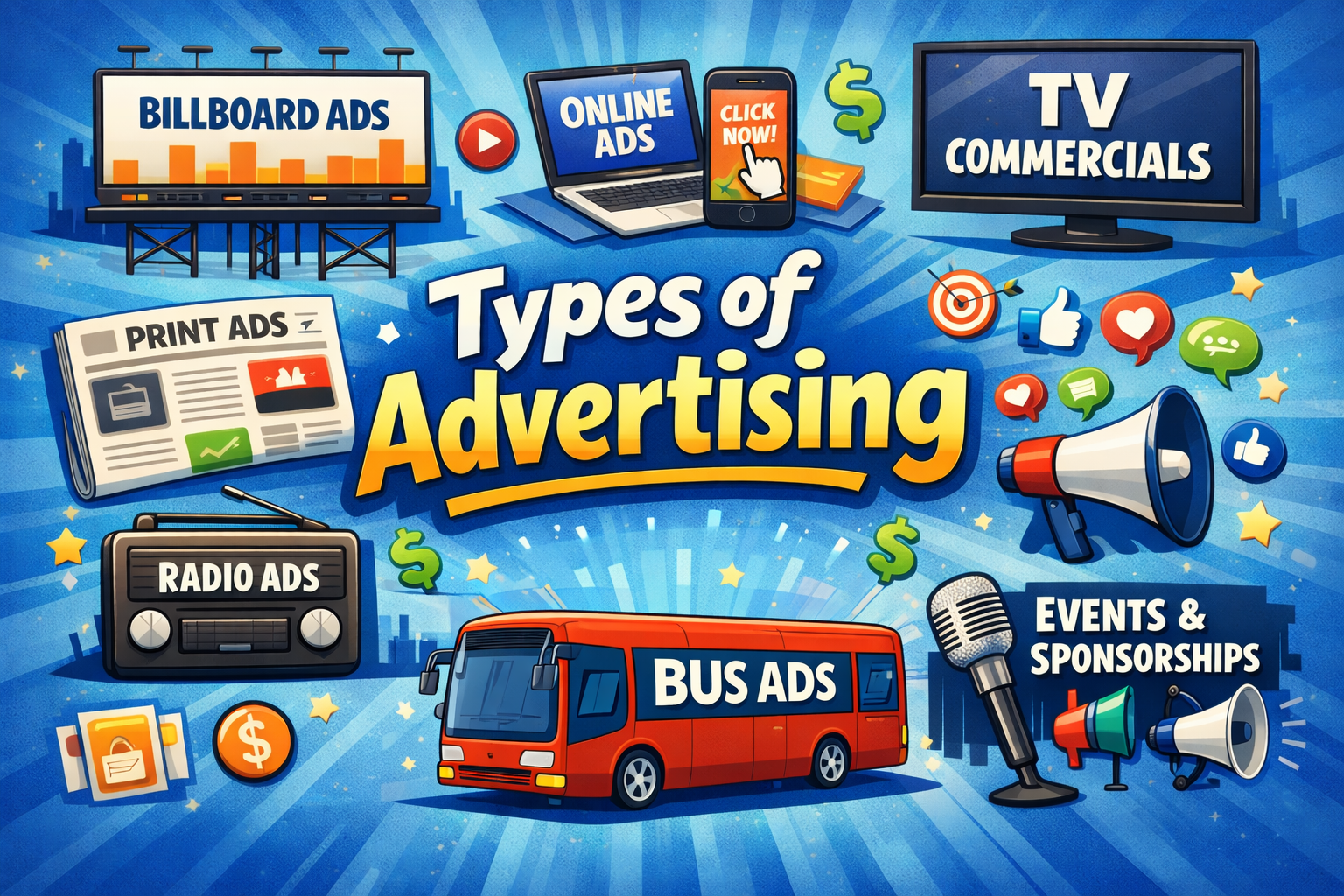
Below are the 10 major types of advertising and how they function.
- Online Search Advertising
- Social Media Advertising
- Print Advertising
- Direct Mail Advertising
- Broadcast, Video and TV Advertising
- Out-of-Home (OOH) Outdoor Advertising
- Cell Phone Mobile Advertising
- Product Placement
- Consumer-Generated Advertising
- Radio and Podcast Advertising
1. Online Search Advertising
Search advertising appears when people actively search for information online. Businesses bid on keywords so their ads appear above organic results. This format works because users already have intent and thus they are researching solutions. Instead of interrupting attention, the ad answers an existing need. Advertisers often send users to dedicated landing pages and track performance instantly.
When used: capturing demand, leads, or sales
Why effective: reaches people at the decision stage
2. Social Media Advertising
Social media advertising is a type of advertising which introduces products to audiences who were not actively searching. Platforms allow targeting based on demographics, behaviour, profession, and interests. Unlike search ads, these create interest. Interaction through comments and shares builds familiarity and trust over time.
When used: brand discovery and engagement
Why effective: combines targeting with interaction
Choose a reliable social media agency in Gurgaon to turn followers into customers.
3. Print Advertising
Print advertising includes newspapers, magazines, brochures, and catalogues. Physical publications carry authority and align brands with certain lifestyles or readership groups. Placement and size affect visibility and impact.
When used: positioning and credibility
Why effective: trusted curated environment
4. Direct Mail Advertising
Direct mail delivers promotional material directly to homes or businesses. Many campaigns connect offline communication with online action through QR codes or links. People often notice physical mail more than digital messages, making it memorable despite slower delivery.
When used: localized and personalized outreach
Why effective: high visibility and personal feel
5. Broadcast, Video and TV Advertising
Video advertising combines visuals, sound and storytelling to create emotional recall. Television reaches mass audiences, while streaming platforms add targeting capability. Even when direct tracking is limited, repeated exposure builds strong brand memory.
When used: mass awareness campaigns
Why effective: emotional storytelling and memorability
Also Read: Cost of Advertising on TV in India
6. Out-of-Home (OOH) Outdoor Advertising
Billboards, transit ads, and street installations reach audiences during daily movement. Repetition reinforces recognition. Creative executions often integrate surroundings, making the ad itself a visual experience.
When used: large-scale visibility
Why effective: unavoidable repeated exposure
7. Cell Phone Mobile Advertising
Mobile advertising includes SMS promotions, push notifications, and in-app ads sent directly to smartphones. Because phones are checked frequently, these ads achieve immediate attention and response.
When used: reminders and time-sensitive offers
Why effective: high open and engagement rates
8. Product Placement
Brands appear inside entertainment content instead of interrupting it. Viewers associate the brand with characters or experiences subconsciously. This builds familiarity without resistance.
When used: long-term brand association
Why effective: subtle persuasion
9. Consumer-Generated Advertising
Customers, influencers, or brand advocates create promotional content such as reviews, tutorials, and testimonials. Peer recommendations are perceived as more trustworthy than direct brand communication.
When used: trust and credibility building
Why effective: authenticity
10. Radio and Podcast Advertising
Audio advertising reaches listeners while commuting or multitasking. Podcast audiences especially trust host recommendations. Repetition strengthens recall over time.
When used: niche targeting and recall
Why effective: attentive listening environment
Also Read: Podcasting Marketing Strategy
Emerging Types of Advertising
Advertising is shifting from interruption to relevance through personalization and automation.
- Influencer Marketing: Brands collaborate with creators whose followers trust their recommendations, turning promotion into relatable advice.
- Programmatic Advertising: Automated systems purchase ad placements in real time using audience data, improving efficiency and accuracy.
- AI-Powered Advertising: Artificial intelligence analyses behaviour and adapts messaging, visuals, and timing for each individual viewer.
What is the Future of Advertising?
The fastest-growing areas focus on precision rather than reach:
- Retail media platforms (ads at purchase points)
- Connected TV and streaming ads
- Creator-led content ecosystems
- First-party data targeting
Advertising is moving from mass messaging to individualised communication.
How to Measure Advertising’s Effectiveness?
Modern campaigns measure the quality of engagement rather than just exposure.
Common metrics:
- Reach & Impressions – visibility
- Click-through Rate – engagement
- Conversion Rate – action
- Cost Per Acquisition – efficiency
- Return on AD Spend – profitability
- Brand Lift – perception change
Different goals require different metrics, like awareness campaigns measure recall, while performance campaigns measure results.
Conclusion
Advertising today is not one channel but a coordinated system. Traditional, digital, and emerging formats each influence different moments in the customer journey. The most effective strategies combine multiple types of advertising so a brand is discovered, understood, and remembered, not just seen once.
FAQs
Q1. What are 5 types of online advertising?
Answer: Search ads, social media ads, display ads, mobile ads, and email ads.
Q2. What type of advertising is more effective?
Answer: Search ads for conversions; video and social ads for awareness.
Q3. What types of advertising are most profitable?
Answer: Highly targeted digital and retargeting campaigns.
Q4. Is advertising the same as marketing?
Answer: No. Advertising is one component of marketing.